Go directly to quips . . . All page numbers relate to the hardback versions.
I am an avid reader. For most of my adult life, I read non-fiction exclusively. In the last few years, I have come to appreciate fiction for the great pleasure it too can provide. A good story to me is one with well-developed characters . . . that draw me in . . . that I like to read about. The genre is not as important to me as the depth and richness of the characters. Characters that grow wiser by the end of the book and are better off for it, can take me to places in my mind non-fiction never could, and for that, I have turned to a good book of fiction after a long day of reading non-fiction. One feeds my mind more and the other my soul.
Since there are thousands of books to choose from, we have the luxury of being particular – “Is this worth my time or not?” is the question I ask. Finding an author I adore and receive inner gifts from is like going to a quilt where I learn something new from seeing it or like finding the perfect fabric for a project. Viewing a shelf of book jackets is the same for me as looking at quilts on exhibit; I look for one that attracts my attention because of the color or design, then I look, or read it over carefully. After viewing many quilts, I may find one that speaks to me so strongly I am moved to dedicate fabric and time to making my vision’s version of it. It’s the same thing with a novel; some I won’t bother to finish, while others . . . well, for me the book becomes a virtual quilt when it wraps me inside of its story.
When you make a quilt, you think about it and talk about the process and inspiration long after it’s over. The same is true with a book that took you in for awhile. The way you interpret what the author is saying is your version of the book. In fact, a book read two times in your life will give you two or more different experiences of it. I don’t imagine it was any different for women making quilts long ago. When they gathered to quilt, they shared their needlework skills, inspiration for making it, and their chosen fabrics and designs. Sharing led to learning something new about each other and themselves. Viewing an art quilt made today or 150 years ago, it doesn’t change the riches of sharing the story that goes with the quilt.
Tidbits about quilts, sewing or textiles written as part of a story, where I both learn something and receive joy, I want to share with you, too. These quoted passages go beyond the more cliché ones we have come to hear over the last few years. They ring true. The authors have used quilts or fabrics as details, to paint a finer picture for their readers, even though they may not respond to it with the same glee a quilter would. I would suggest the talk of quilts and needlework icons is on the increase because they form a bridge cutting through all ages, groups, genders, time periods and cultures.
The quotes are not from books that fall under the quilt fiction category; they are from biographies, historical fiction, and plain ol’ contemporary novels. Technically, a biography is a work of non-fiction, but the one I have included is a daughter’s story about her father’s life, not a scholarly study of someone famous and deceased. The books, not just the passages quoted, warmed my spirit, brought tears of sorrow and joy, and piqued my fabric-loving self when they unexpectedly came up in an otherwise non-quilt or fabric narrative. Some of the stories recount the preciousness of needles and thread to women before us. Other stories fluff our material passion, while others use the geometry of a quilt stitched pattern to complete their verbal picture.
Finally, I want to thank the authors who have written these wonderful books, which have brought me great pleasure through their words and their desire to tell me about themselves through their characters that in turn, tell me about my self, about others and about the past. I deeply appreciate the work they put into their book, and it is my pleasure to share with you the titles and a very brief description of the story, from my point of view. After reading a book and discovering its value to me, I like to lend it and re-read it and to look at it on my shelf . . . like my stash of fabric . . . and occasionally, I pet it.
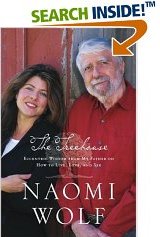 The Treehouse, Eccentric Wisdom from My Father on How to Live, Love and See. The Treehouse, Eccentric Wisdom from My Father on How to Live, Love and See.
By Naomi Wolf 2005, Simon & Schuster 0743249771
Naomi’s father, Leonard, is a retired poet, professor of creative writing and self-proclaimed eccentric collector. The book is not merely about his life, which began in Rumania, and his childhood emigration to the US just before the Great Depression, or about the writing and poetry movement in the 1940s, which started romanticized views of the world emerging post-war. It also tells about Naomi’s growth as a teacher and public debater on social issues important to women and about her renewing her relationship to her father, as they write this book about living a creative life. Each chapter is named for a Key to living a life with one’s creative passion at the leading edge. The biography is weaved in and out of the creative lessons. And yes, there is a treehouse being built for Naomi’s kids by Naomi, her father and her friends, at her home in the Hudson River Valley of NY.
Today my father’s humanism is an old-fashioned, even discredited, point of view; a faded idea, like a jacket cut to the body and altered by hand. (page 89)
Rose-Ita tried to decorate the bare wood of the walls by cutting cloth into shapes and sewing them into wall hangings. In one, a woman’s figure is surrounded by a half-dozen chickens, and the Hungarian legend reads, “A busy woman makes a happy life.” She made lacework and draped it on the simple wooden furniture (Leonard says “There was no upholstery until we got to America.”). She was an artist, though that concept would never have occurred to her,” recalls Leonard. Rosa-ita’s lacemaking, her cooking, and her arranging of bright scraps into wall hangings also eased the sting of bare wood and the six years of loneliness a bit. (pages 58-59)
There had been no one to dress up for in the Old Country. She now put away her ankle-length dresses, acquired a girdle, and took to wearing floral cotton housedresses that fell just below the knees, as “real” American women did in 1930. The boys – who had been photographed in Rumania, standing proudly in white curled-lamb fur coats like little Russian princelings, their black hair combed with oil that shone in the photographer’s light - quickly learned to wear newsboy caps and knickers, and to play in dirty vacant lots, or else face the consequences. (page 62)
 The Art of Mending The Art of Mending
By Elizabeth Berg 2004, Random House Mending refers to mending a family. The story is one that unfolds as it goes on, so I won’t ruin it for you. The fictional teller of this story, the sister of the wounded person, is also a quilter, an art quilter. This book has humor, as Elizabeth Berg’s books do, and is so a part of the story it simply serves to bring you more close to the characters. Her writing is so wonderful, in my opinion; I have included two of her books in this article. I think she must be a closet quilter.
I make my living as a quilt artist, and for the most part the work I do is commissioned. I charge a hundred and fifty dollars a square foot, not without guilt. But I have whole days when I stand as my design board moving pieces of fabric around, and I don’t sew a stitch. Then something clicks, and I hit the machine. The money I charge pays me for thinking time too; I explain this to my clients. And people do pay it, willingly – I have more clients than I can handle. The wait for a finished quilt is four to six months, but people don’t seem to mind that, either. I think there is a longing for things that reflect a certain kind of slowness; perhaps the pendulum is beginning its inevitable swing back. (page 19)
He owns the hardware store in the center of town, and he loves being there. It’s how I met him. I’d come to town for a quilting convention, and needed some wooden dowels. For me, it was love at first sight – I asked him out to dinner that night, and by the time we had dessert I was fantasizing our fiftieth anniversary celebration. (page 20)
Today I needed to go to the fabric store to select the yardage I wanted to use for the border of a quilt I was making with Japanese overtones. It was for a woman who believed she’d lived many times before and that one of those past lives was as a geisha. It’s funny how people reveal themselves in the quilts they commission. One client had a bitter divorce but she wanted me to use her wedding dress to make a quilt that honored marriage. A truck drive commissioned a wildly feminine floral design to sleep under when he was on the road. A woman alienated from both her children had saved every item of clothing they’d ever worn as babies and toddlers, and she had me use them…” (page 20)
She began cutting and we stopped talking, both of us listening, I think, to the sound of the scissors. For those of us enamored of the world of textiles, this sound is a little symphony. It conjures up an image of a head bent over a machine, the feel of fabric slipping through the fingers, a small light focused on a field of intimate labor. (page 24)
 The Last Days of Dogtown The Last Days of Dogtown
By Anita Diamant 2005, Scribner
The setting for this book is Cape Ann in the early 1800s. It follows the life of several families and individuals until their death. There is a love affair between a free spirit herbalist and a free slave that begins the book, but a plethora of characters and another affair drive the main story. For me it was rather slow story, missing an apex, but it describes life in those times in New England, and it is character driven. It kept my interest to the end.
He took the four posts from their corner and set them standing in the notches he’d cut in the floor long ago. Then he got the key from its nail on the wall and turned it until the ropes were taut and tight between the posts. Judy carried the mattress and together they unfolded it over the webbing. Without a word, he reached for the quilt and together they laid it out. (page 21)
The flat capping stones on top would keep rain and snow from loosening the wall below. Much better, Ruth thought, though she disagreed with his placement of one handsome rock, pale with black seams, almost like stitching on a quilt. (page 62)
She had churned so much she’d had to wrap some of the butter in strips of yellow gingham instead of white linen, and she’d been rehearsing ways to insult the shopkeepers if they made any complaint about the difference. (page 155)
But Judy knew better. She would always be a lighthouse of gossip, a beacon signal reminding people of the shocking tale of a Black Neal and his Dogtown mistress. They might stop snickering into her face. They might forget to curl their lips when they told her they had no green thread in stock when the spool was in clear view… or when she left the shop… all kinds of indecent details [would be] invented out of whole cloth. (Page 259)
 Liberating Paris Liberating Paris
By Linda Bloodworth Thomason 2004, Harper Collins
This is a book of 40-somethings going through their mid-life readjustment in a small town in Arkansas, which is being destroyed by the opening of super sized Fed-Mart. The characters are deep, diverse, and out of the ordinary for a book of this type. They are totally believable and likeable. It was funny, sweet, well written and fabulous by the time it was complete. It touched me very much, but I’m a sap for books about a group of close-knit friends going through major life changes without drugs and other morally decrepit crutches to make the journey, well hardly any decrepit crutches.
Over the years, she had taken good care of Jeter.…she found a special homeopathic cream for his bedsores that worked.…And best of all, she had used her childhood sewing skills to make him a beautiful quilt of brightly colored, velvet squares. Jeter liked the way the lush fabric felt next to his face. Nothing in recent had soothed him more than Milan’s hand-stitched comforter. (page 90)
Something Slim had learned since leaving Casablanca was that Sidney, at the tender age of twenty, was a silk procurer for a major fabric house in Belgium. But the thing that completely dazzled her was his expertise and knowledge of silk. Right now he was explaining how Moroccan farmers carry the eggs of silkworms close to their chests in order to keep them warm, and also how they speak softly, so as no to startle them. Then, he said, after the eggs hatch, each worm spins a cocoon, which is then boiled until the end of the silk thread unravels. He described how each individual fiber is lustrous and strong on it’s own, but the more it bonds and is woven with other fibers, the more fragile and delicate the fabric itself becomes – so that eventually, if even one thread is pulled, the entire piece will be ruined . . . Then he casually mentioned that one client in particular, The house of Worth, used only silk from Marrakech because of the loving care the farmers gave to their worms. (page 230)
 New Mercies New Mercies
By Sandra Dallas 2005, St. Martin’s Press
After Sandra wrote, “The Quilt that Walked to Golden,” she wrote this mystery story situated in Natchez, Mississippi, in the second quarter of the 20th century. The main female character and narrator lives in Colorado, when she learns she has inherited an old falling down mansion from an eccentric Aunt she never met. The little-known Southern family’s story unravels itself throughout the book, and simultaneously we follow the story of the narrator’s very different life as a wife and divorcee. The Southern characters and their colorful ways in juxtaposition to the Aunt’s former slaves, who remain enslaved by the town, make for an interesting read. The overriding theme, in my take, is one of compassion and tolerance.
I selected a bottle of Coca-Cola from a tub filled with tepid water and handed her a nickel, which she put into a drawer under the counter. She took the bottle from me and opened it, and while I sipped the cola, she pried up the cork that lined the bottle cap, placed it inside the bosom of her wash dress, then put the metal capon top of it and pushed the cork into place so that the cap was affixed like a brooch….Two little girls in dresses made from flour sacks played jacks in front of a building where a broken iron balcony hung precariously over the street. (page 102)
“I got to be the house girl. I was never no good at chopping cotton, but I was a terror with a broom.” Her whole body shook when she laughed. “I live there before that place go down, till I commenced to be prosperous and took on this store. My feets has been in this place forty years.” She picked up a crochet hook and worked it back and forth, using yellow strings from tobacco bags. (page 104)
The marble image was nearly life-size, and I walked around it, studying the young woman, who had been half my current age when she posed….”IS that really the way she appeared?” I asked Ezra. “She was always looking fine as silk.” More like osnaburg in her last years, I wanted to tell him, although I did not. (page 115)
Aunt Polly had tacked up outdated calendars and magazine pictures , and an old-fashioned sampler, soiled from smoke and grease, was pinned to the wall next to me. Across the top was a crude alphabet embroidered in black, and beneath it were two dancing stick figures with black heads and the words WEZ FREE.
Aunt Polly saw me looking at the needlework and grinned. “Miss Emilie, she done the letters when she’s a girl and throw it out for a rag. But I keep it and finish it off when the freedom come. Miss Amalia help me with the words.” (page 152)
 Open House Open House
By Elizabeth Berg 2000, Random House
Oprah chose this for her book club years back, but that didn’t make me read it- no. It was the William Morris wallpaper, on the book cover, situated over the claw foot metal tub with stenciled stars on the side and harlequin tiled floor. Elizabeth is a quilter, she must be, in real life. Her protagonist is going through the readjustment following the end of her marriage. Her husband left her and her teenage son, for another woman. She is devastated but a spit fire and the book is a joy to engage with. It is not just another woman scorned who goes on to thrive story… the dialogues are, inner and outer, are humorous, contemporary and easily related to I think. She is fearless and fearful and you are rooting for her every step of the way.
I go into the basement to start a load of wash. When I begin separating, I find a pair of David’s boxer shorts, the blue ones, and, God help me, I bury my face in them for the smell of him.
Look up and see my sewing machine. I bring his shorts over to it. Then, using a hidden seam, I sew the fly shut. With great care, I do this, with tenderness. Then I go back to the pile of laundry and get some of his fancy socks and sew the tops of them shut. (page 10)
All right: the red against the blue, the sound of the birds in the morning. The sugar smell in bakeries. The smoothness of fabric moving under my hands into the teeth of the sewing machine. The movement of the ocean, the break of light every morning, every morning.
"Hey,” I say softly, just to hear the sound of my own voice. I sit perfectly still, hear the tap drip, then drip again. “Hey!” I yell. “I’m here!” (page 139)
Back to top All quotes are copyrighted to the author and publisher of the book. All other text is Copyright © 2006 by Kimberly Wulfert, PhD. All rights are reserved. |