|
 |
Contact Information:
Mary Bywater Cross
2141 NW Davis St. #503
Portland, OR 97210-3578
11 Shoreland Dr. Lopez Island, WA 98261
Cell (503) 784-0581
mbcquilt@web-ster.com
|
1) How do you prefer to be described, within the field of textile history?
If you have a business, please tell us
about that.
“I prefer the titles of quilt
historian, artist, and consultant."
2) When and where did you begin your serious interest in the history of quilts, textiles or garments?
"After my grandmother Harriet Smith McNeill introduced me to quilts through the
small family collection she inherited, my interest was whetted. In 1979-1980, I
was able to take a yearlong college-level course at the Oregon School of Arts
and Crafts, now known as the Oregon College of Arts and Crafts. The course,
taught by one of my mentors, the late Marie Lyman, included quilt history,
construction, and piecing and quilting techniques from around the world.
"The time was early in the current quilt revival. It was relatively easy to
access the few books available and to be very thorough in our study. Marie was a
perfectionist, a detail person. She had trained as a librarian and was consumed
by a passion for textiles and quilts. We did everything by hand and were
required to present in class our papers and projects for critique. She taught us
to look at older quilts for design ideas and pattern research. Quilt
Engagement Calendars were the best resource. As a class, we reproduced a
classic Amish quilt in wool.
"The impact on me was major. From that course, I defined my direction in
making quilts from new wool cloth of my own designs drawing on my Iowa
background of my grandmother saving buttons and wool squares from old clothes."
3) What “known” individual (or group) influenced you most and why?
"The members of the American
Quilt Study Group
"I was introduced to the group in the fall of 1981 by DeLoris Stude, the
long-time coordinator of the West Coast Quilters’ Conference. She invited me to
attend the annual seminar. My first roommate was Lucy Hilty, one of the “stars”
of “Quilts in Women’s Lives.” I thought I had really arrived!
"After that first seminar in the early ‘80s, I was inspired to create a regional
quilt study group, the Columbia-Willamette Quilt Study Group, based on the
guidelines from the book Independent Scholar and the research paper
presentation concept of AQSG. I thought that perhaps papers could first be
prepared and presented locally and then be proposed for the AQSG Seminar.
Instead, the group evolved to be more of a contemporary quilt group with a focus
on quilt history, studio tours, gallery exhibitions, and special events.
"Now, when the group meets for the annual retreat, two important projects are
conducted. One is the Lottery for Latimer, the Quilt and Textile Center in
Oregon. Members bring items to contribute, make a donation to Latimer, and have
the right to choose an item. The other project is a social outreach for the
Dougy Center, the International Center for Grieving Children based in Portland.
Each year, the associate director Joan Schweizer-Hoff identifies a textile
project we can do at the retreat.
Over the years I have maintained an active membership in AQSG serving on the
Board of Directors in the early ‘90s; presenting two seminar papers; and
donating auction items; and serving as a mentor for new scholars. One of those
new scholars is Bill Volckening from Portland who is now contributing regularly
to the AQSG internet discussion group. My legacy to the organization has been
the Regional Coordinator Program I structured and developed. I am extremely
pleased the program continues today with regional study groups and area
representatives in 35 states and Canada."
4) Who became your personal mentor as you began your learning?
"Marie Lyman was my first mentor. After the overview study course, we scheduled
a conference
to help me define the direction I wished to take my quilt interests. She helped
me focus my interest on researching and writing quilt history and on making
woolen quilts. She encouraged me to travel, to inquire, and to use the skills I
had learned in library science for research. When I began to teach my workshops,
I organized the class format in a similar manner to Marie’s – a participatory
class with students making presentations.
"Over the years, we supported each other’s passions and professional goals. In
the late ‘80s, we curated an exhibition of new traditional and contemporary blue
and white quilts for the University of Oregon Museum of Art. That exhibition
traveled internationally for two years.
"Unfortunately, she took her life in October 2000. She suffered breast cancer
and on-going depression.
"I was able to orchestrate a fitting tribute to Marie by having her signature
quilt “Morning Light Studio” donated to the International Quilt Study Center
along with a variety of her teaching materials and notes. She is now recognized
as one of those artists working in the early days of the quilt revival to create
quilts as works of art."
5) What aspect of study were you most passionate about at first? How has this changed over time and why?
"I continue most
passionate about quilts as valid documents of human experience. I love
researching historic quilts, the link to the makers, and their life experience
and community. Initially, I check in the quilt’s physical aspects – the size,
date, types of fabrics, and place it was made. Then, I’m fascinated in what I
can learn about the quilt’s intended function; the maker’s social, economic, and
cultural life; and the aesthetic influences from her community. These were my
research guidelines as I studied migration quilts; lectured for six years for
the Oregon Council for the Humanities as a Chautauqua speaker; and now serve as
an advisor to the Oregon Quilt Documentation Project. It is an amazing adventure
to meet people in their communities; seek out their quilts; and listen to them
share their experiences; and then to expand their appreciation and awareness of
their quilt’s place in history."
6) What is your current
“pet project”?
"Two projects are scheduled for 2011.
"In March, contemporary quilt artist Barb Nepom and I are co-curating an exhibit
of our works for the Lopez Island Library in Washington state. Barb does
wonderful art quilts of hand-dyed fabrics and I do the woolen quilts. Our pieces
complement each other beautifully. We exhibit together during the Lopez Island
Studio Tour held each Labor Day Weekend on the island.
"Also in our show we’ll feature the small quilts by quiltmaker Andrea Leong
Balosky between 1999-2002. These began as a project using her scraps and evolved
to be one of recognizing people she admired who came to mind as she was
stitching each piece.
"In October, the three-month exhibition I’m curating of the quilts from my
Oregon Trail Quilt Project will be hung at the Willamette Heritage Center at
Salem, Oregon’s Mission Mill Museum. This will be the first exhibit since the
original touring one in 1993. My book has been revised; renamed Quilts of the
Oregon Trail and expanded with new quilts, resources and a focus on women’s
roles in the building of community in the Pacific Northwest."
7) What aspect of your research or contribution to textile studies has satisfied you the most?
"I continue to be most satisfied with opportunities to introduce quilters and
non-quilters to the world of quilts. I receive great pride in being able to
“pass along” expertise, knowledge, quilts, and opportunities in the field to
other scholars and museums. These are the kinds of activity I feel are important
to broaden the audience for quilt history and to increase our support.
"In 2009, I passed the responsibility for the leadership of the
Columbia-Willamette Quilt Study Group to textile historian Martha Spark. I was
thrilled when she approached me about having a study group in Oregon. I
immediately offered her the name and concepts I had used to create it originally
in the early 1980s. My role has been to be supportive and to make formal
presentations on the quilts I encounter in my continuing travels.
"Martha also expressed an interest in re-establishing the Oregon Quilt
Documentation Project which I had begun in the early 1990s. Again, I was
thrilled to pass the leadership to Martha and Bill Volckening, as co-chairmen.
My role is as an advisor and a resource.
"In recent years, I’ve seen subjects resurface that I was initially interested
in twenty-thirty years ago. I was able to exhibit a quilt from the family of the
artist Grant Wood at an exhibit at the Virginia Quilt Museum. Then, I worked
with Mary Robare, the curator, to have the quilt permanently donated to the
Museum of the Shenandoah Valley in Winchester where the Quaker family originally
resided.
"In 2008, I lectured at Bath’s American Museum in Britain. While there I
presented to their collection one of the quilts from the Oregon Trail Quilt
Project, much to the thrill of the donor, her family, and the museum. The quilt
connected the time period of the museum’s major collection to the Oregon Trail
experience and enriched their quilt collection.
"My books have continued to have “lives of their own.” The most recent project
was the use of the quilt patterns as part of the public art on Portland’s light
rail system at the Clackamas Town Center station. Artist Richard Elliot designed
42 cut steel panels showcasing each of the pieced patterns. A further compliment
was to have my Cross and Crown logo used as one of the patterns.
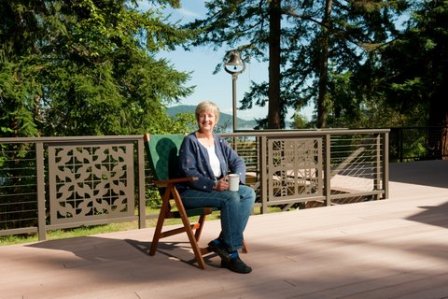
"A follow-up project I did was to use 12 panels as the deck railing at Cross
Bywater, my Lopez Island home. They are magnificent!"
8) Within this arena, what would you like to do, but haven’t done yet?
"As I read over my previous answers to this question, I realized I have been
very fortunate to be able to achieve lecturing abroad; contributing locally to
the historical activities within my region’s museums; and pursuing my interests
in making woolen quilts. I have been blessed!"
9) Any further comments are invited.
"The woolen quilts I make are also an important part of my quilt art. Currently
I’m working to reduce my inventory of beautiful woolen fabrics. I have several
on-going projects to achieve this goal.
"One is to create commission quilts where I invite the client to select a “focus
fabric” from my inventory. Then I create the one-of- a-kind piece to their
requested size. I reflect on our friendship as I work using fabrics or buttons
from their family’s collections and further personalize each piece by using
handquilting designs meaningful to them. When I present the quilt, I include
construction and artistic statements.
"Another project is participating in the Lopez Island Studio Tour each Labor Day
weekend. This is an opportunity for me to make smaller pieces relating to the
buyer’s personal connection to the San Juan Islands and their history. Because
many people arrive on bicycles, I also make table runners and narrow wall quilts
that can be rolled up and put in a bicycle bag."
10) Please describe (in a list) the contributions you
have made via books, exhibits, presentations, contests, articles, fabric
lines, research papers and the like.
Quilt historian, author, curator, artist, and consultant
Historian
Publications
-
“Quilt Piecing on the
Oregon Trail in 1849,” American in Britain, American Museum in Britain,
Bath, England, 2008
-
Quilts of the Oregon Trail, (Atglen, PA: Schiffer Books, 2006)
-
"The Anti-polygamy
Quilt by an Ogden Methodist Quilting Bee,"
Uncoverings 2003, (Lincoln, NE: American Quilt Study Group, 2003)
-
“A Visual Record Study: Quilts in the Lives of Women Who
Migrated to the Northwest, 1850-1990,”
Women in Pacific
Northwest History;" Seattle: University of Washington Press, 2001.
-
“Quilts and Women of the Mormon Migrations: Treasures of
Transition,”
Nashville, TN: Rutledge Hill Press, 1996.
-
“Treasures in the Trunk: Quilts of the Oregon Trail,”
Nashville, TN: Rutledge Hill Press, 1993.
-
“Postcards from Treasures in the Trunk,”
Nashville, TN:
Rutledge Hill Press, 1993.
-
“The Quilt Revival,” Women's Journal, April, May, June
1994.
-
“Common Threads,” Iowa Alumni Review, University of
Iowa, Winter 1993.
-
“Quilts of the Oregon Trail,” Oregon Humanities, Winter
1992.
-
“Quilts of the 1929 Oregon Quilt Contest,”
Bits
and Pieces, Lewisburg, PA: Oral Traditions Project, 1991.
-
“Women's Work: A Study of Quilts,” exhibition
catalogue, Portland, OR: Columbia Willamette Quilt Study Group,
1985.
-
“The Quilts of Grant Wood's Family and Paintings,”
Uncoverings
1982, San Francisco, CA: American Quilt Study Group, 1982.
Plus numerous articles in quilt and needlework publications:
Lectures
- “Quilts of Migration” and
variations on that theme
- “Quilts: Heirlooms from the
Homefront”
- “The Ties that Bind: Quilts
made in Community”
- “Grandmother’s Garden:
Reflections on a 1930 Oregon Quilt Contest”
- “Quilt Patterns Providers and
Promoters of the Colonial Revival 1890-1930”
- “Historic Quilts as Metaphors
in Art and Literature”
- “Woolen Quilts”
- “Oregon Heritage Quilts”
- “The Solar System Quilt”
Workshops
- “Treasures in Your Trunk:
Discovering the Clues”
- “Quilt for The Hired Man:
A Personal Design Exploration”
Special Presentations
- “Thimble Tea: A Quilt Sharing”
Curator Exhibitions
- 2011 “Small Wonders: Quilts by
Andrea Leong Balosky, Lopez Island WA Library
- 2004 “Feast Your Eyes on
Quilts: Vegetable Quilts,” Museum of the Oregon Territory, in
conjunction with a Smithsonian traveling exhibition
- 2002 “Quilts: Heirlooms from
the Homefront,” Museum of the Oregon Territory, Oregon City
- 2001 “Pieced and Quilted
Gardens,” Museum of the Oregon Territory, Oregon City, OR, in
conjunction with a Smithsonian traveling exhibition
- 2000 "Quilts: Stitched Records
of Human Experience," Washington State University Holland Library
Archive, Pullman, WA
Artist Exhibitions and Sales
- 2011 Lopez Island Library,
Lopez Island, WA
- 2010 Lopez Island Labor Day
Weekend Studio Tour
- 2010 Lopez Island Community
Center, Lopez Island, WA
- 2010 U.S. Bank, Stadium Bank,
Portland, OR
- 2009 Chimera Gallery Guest
Artist, Lopez Island, WA
- 2008-09 Craftsmen Among Us,
Trinity Episcopal Church, Portland, OR
- 2006 Albina Community Bank,
Portland, OR
- 2005 Local 14 Women’s Art Show
and Sale, Portland, OR
- 1988-05 Quilters' Market
Semi-Annual Sales, Portland, OR
Thank you very
much, Mary, for sharing yourself with us today, and for the insights we
have gained because of your efforts in this field. Continued success to
you. |