|
If you recognize a name or date and
place on the list, please contact me with your input. Perhaps together we
can weave the history of this signature top and find out how they put the
fabric in their typewriter and why! Most of the signers, both men and women,
are from New England states.
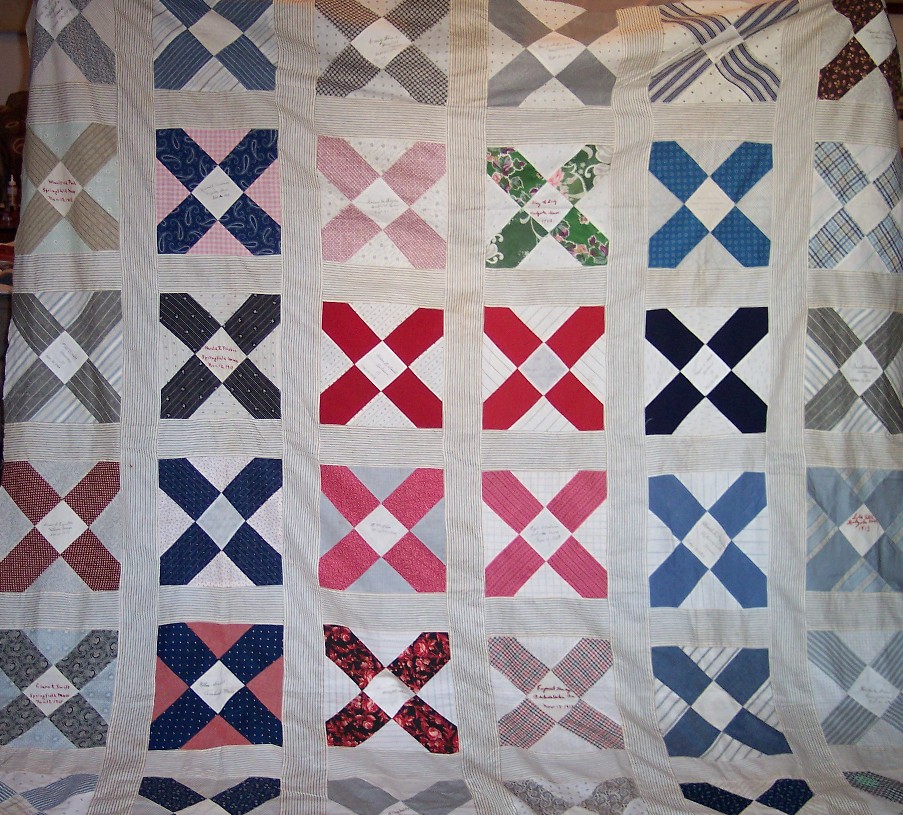
Overall Description of the Top
 There
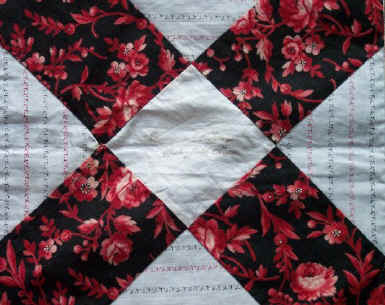
are 36 blocks measuring 10"x10", in a pattern called Old Italian Block by
Brackman, (Encyclopedia of Pieced Quilt Patterns, #2881, by Nancy Cabot) It
is commonly used for signature quilts, and is sometimes called Railroad
Crossing. Each block is signed using a wide variety of methods, in the
center square. Most are dated November 12, 1913, but range from 1910 to
1916. Most of the blocks are hand sewn. The majority of fabrics look new,
with starch or sizing on some. Only one fabric repeats, and is used within
the same family. This suggests that the fabric and block was made and signed
by the signer, then sent to one woman, who used a sewing machine to complete
the quilt top. Her sewing skills indicate that she was not use to using her
machines, there are some tucks and loose threads here and there. The names
are signed in different directions, indicating they signed them before
sending them to her. The fabrics are common early 20th century prints made
or sold in America. There
are 36 blocks measuring 10"x10", in a pattern called Old Italian Block by
Brackman, (Encyclopedia of Pieced Quilt Patterns, #2881, by Nancy Cabot) It
is commonly used for signature quilts, and is sometimes called Railroad
Crossing. Each block is signed using a wide variety of methods, in the
center square. Most are dated November 12, 1913, but range from 1910 to
1916. Most of the blocks are hand sewn. The majority of fabrics look new,
with starch or sizing on some. Only one fabric repeats, and is used within
the same family. This suggests that the fabric and block was made and signed
by the signer, then sent to one woman, who used a sewing machine to complete
the quilt top. Her sewing skills indicate that she was not use to using her
machines, there are some tucks and loose threads here and there. The names
are signed in different directions, indicating they signed them before
sending them to her. The fabrics are common early 20th century prints made
or sold in America.
The sashing is a man's striped shirting,
which has multiple thin black lines, in two different widths on white. It
runs horizontal and vertical at 3"- 3.25" wide. It is attached by machine.
It does not form an outside border, there is no border there.
Click to enlarge.
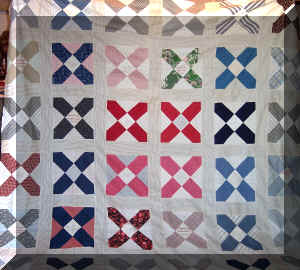 Overall,
it makes a masculine impression, with a majority of men's shirtings,
textured and printed, chambrays and woven checks. Four red blocks are placed
in the center, with blue or black strips of blocks running vertically on
either side of center. The outer vertical strips of blocks are made in
various shades of tans and grays, and there are two brown prints, dress
prints most likely. Overall,
it makes a masculine impression, with a majority of men's shirtings,
textured and printed, chambrays and woven checks. Four red blocks are placed
in the center, with blue or black strips of blocks running vertically on
either side of center. The outer vertical strips of blocks are made in
various shades of tans and grays, and there are two brown prints, dress
prints most likely.
The condition overall is good. It does
not appear to have been used or backed. Threads from sewing the sashing on
by machine have not been cut off, and are mainly on the back. Four of the
blocks are damaged: two have been chewed probably by a mouse along the
bottom edge (R1, #2) and at the top of that row, R6, #2, indicating it was
folded when this happened; R5, #6 is signed with a typewriter and the
letters are faded, some are nearly gone; and R1, #1 appears to have a greasy
and dirty substance on it's back side, which shows to a high degree on the
surface of the white square.
The Uniqueness of this Quilt Top
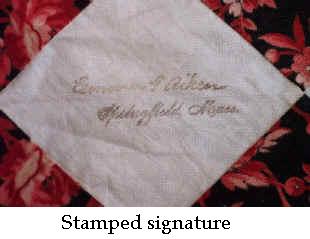 Multiple
methods of signature signing on one quilt are unusual to
find. This quilt is a minefield looking at it from that
perspective, embroidery, different types of inks, stamps, and
pencil. The penciled blocks were probably intended to be
embroidered over. Even more unusual is that some of these names
have been signed by a typewriter. This article will describe
each block separately for the signing method used, where
the maker lived and the fabrics each chose. Perhaps the reason
for this friendship quilt will emerge, as there is not a special
or central block with a description or label to tell its story. Multiple
methods of signature signing on one quilt are unusual to
find. This quilt is a minefield looking at it from that
perspective, embroidery, different types of inks, stamps, and
pencil. The penciled blocks were probably intended to be
embroidered over. Even more unusual is that some of these names
have been signed by a typewriter. This article will describe
each block separately for the signing method used, where
the maker lived and the fabrics each chose. Perhaps the reason
for this friendship quilt will emerge, as there is not a special
or central block with a description or label to tell its story. |
Block Signatures and Descriptions
The inscription and punctuation is copied exactly as it is written on the
block, then the method used to write it, a description of the fabric it's
written on, then the fabric cross, then the background triangles. Some
include method of construction.
Row 1 is the bottom row. The left block
starts the list. There are 6 rows of 6 blocks.
Click on
thumbnails to enlarge.
L.C. Carleton Meriden Conn. Nov.
12 -1913, Pencil in script on textured white on white shirting (the dirty
piece in the quilt, oil?) Blue and white chambray stripe; small black motif
on white shirting; by machine
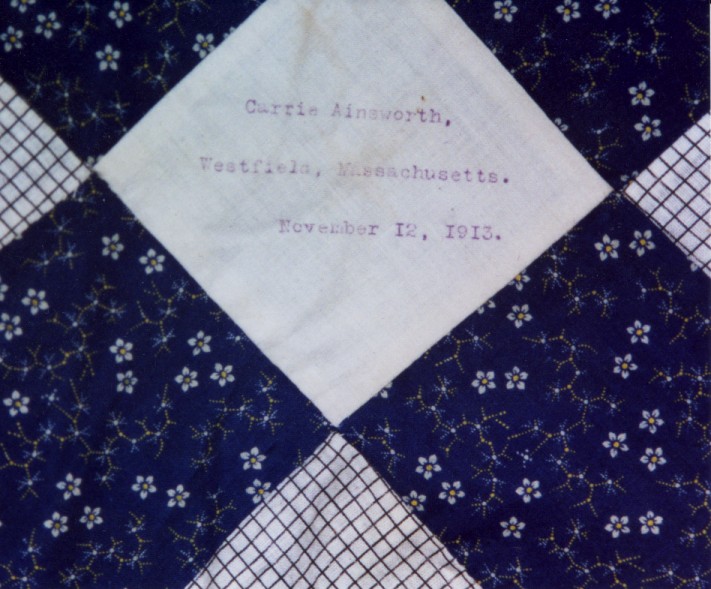
 Carrie
Ainsworth, Westfield, Massachusetts. November 12, 1913. (Signed in same
type on 2 blocks) Typewriter written with aniline-purple ink, on plain white
cloth, possibly broadcloth. Indigo, chrome orange and white print of tiny
flowers and pin dots, synthetic indigo, printed not discharged; black on
white grid formed by 1/8" squares printed on. There are two mouse bites
along the bottom edge of this block only, sewn by hand Carrie
Ainsworth, Westfield, Massachusetts. November 12, 1913. (Signed in same
type on 2 blocks) Typewriter written with aniline-purple ink, on plain white
cloth, possibly broadcloth. Indigo, chrome orange and white print of tiny
flowers and pin dots, synthetic indigo, printed not discharged; black on
white grid formed by 1/8" squares printed on. There are two mouse bites
along the bottom edge of this block only, sewn by hand
Mr. R. B. Corbatt, Holyoke, Mass.
Nov. 12. 1913. (see R1, #6, and row 6, #1)
Brown fountain pen ink, feathered out on the fibers, in script, on polished
white cotton
Tiny woven black and white check; textured shirting of thin ecru stripe on
white; by hand
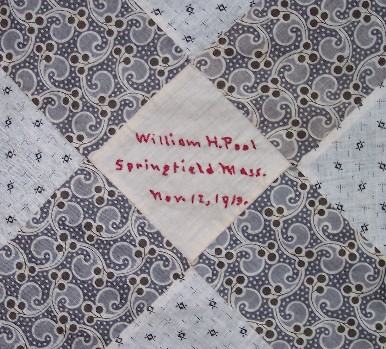
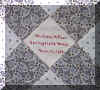 William
H. Pool Springfield. Mass. Nov. 12, 1913. (Winnifred Pool row 5,#1).
Embroidered with dark Turkey red floss, short stem stitches form printing,
on plain white Gray, in 3 shades on white forms a medium-scale circular and
polka dot print; 2 black motifs on white shirting; by hand William
H. Pool Springfield. Mass. Nov. 12, 1913. (Winnifred Pool row 5,#1).
Embroidered with dark Turkey red floss, short stem stitches form printing,
on plain white Gray, in 3 shades on white forms a medium-scale circular and
polka dot print; 2 black motifs on white shirting; by hand
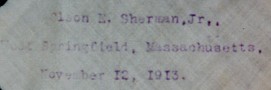
Cleon E. Sherman, Jr., West
Springfield, Massachusetts, November 12, 1913.
(Signed in type on 2 blocks , see R2,#5) Typewritten on plain white block, same
fabric as in Row 1, #2; indigo (synthetic) white prints of dots and cheerios
(not discharged) twill fabric; blue textured stripe on white shirting; by
hand; seams pressed open, like garments
Mr. F. (or L.) H. Corbatt,
Holyoke, Mass. Nov. 12.1913. (same pen & writer as R1,#3)
See Row 1, #3 for signage info and fabric; a novelty woven black and white
check, with green embroidery floss woven by machine to form a pattern about
2" long x 1". The light green floss is woven to fill in the white squares
and go under the black ones; same ecru striped shirting fabric as Row 1, #3;
by hand, seams overlap stitched to prevent fraying
Row 2
Clara K. Swift Springfield Mass
Nov. 12, 1913 (see R1,#4)
Hand embroidered with TR floss, plain white, same as R1,#4; Shaker gray
coloring, paisley in black and white on gray ground, black daisies and
sprigs cotton print; medium blue on white grid and pin dot print, very
detailed, cotton, sewn by hand
Ellen Sowell Amherst Mass Black ink, in script, on a heavier white cotton;
Indigo (synthetic) with white printed small polka dots set apart, spaced
evenly; pink-red chambray; by machine
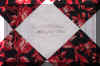 Emma
G (-?) Aiken Springfield, Mass. No date (Mr. Aiken in row 3, #3) Emma
G (-?) Aiken Springfield, Mass. No date (Mr. Aiken in row 3, #3)
Stamped in brown and black ink, two different stamps were used, the name in
brown and it may be handwritten, and the location in black, on polished
cotton with uneven threads, not like chintz. Garibaldi red and pink floral
print, in medium scale, on black cotton with a conversation print of tiny
red and black anchors lined up by color in rows forming stripes on white
ground; by machine
Eugene G. Haley Philadelphia Pa
Nov. 12 1913
Embroidered in dark Turkey red floss in script of stem stitches, on plain white
cotton, Small woven plaid of red and blue on white made of fine thread,
shirting; textured woven white cotton with printed tiny red dots evenly
spaced; by hand
Cleon E. Sherman, West
Springfield, Massachusetts, November 12, 1913. (Signed in type on 2 blocks,
see R2, #5) By typewriter, very faded, same description as R1, #2 & #5; gray
chambray; textured shirting of gray stripes on white and white on white
textured stripes too, by hand; seams pressed open
Bertha M. Dame, Springfield Mass.
Sept. 20, 1910 (last numeral is smeared, hard to determine; Black ink,
script, some feathering on plain white sheeting fabric; gray in light and
medium stripes printed on to cotton; a diaper of tiny black motifs and dots
on white, could be a shirting; by machine
Row 3, #1 left side
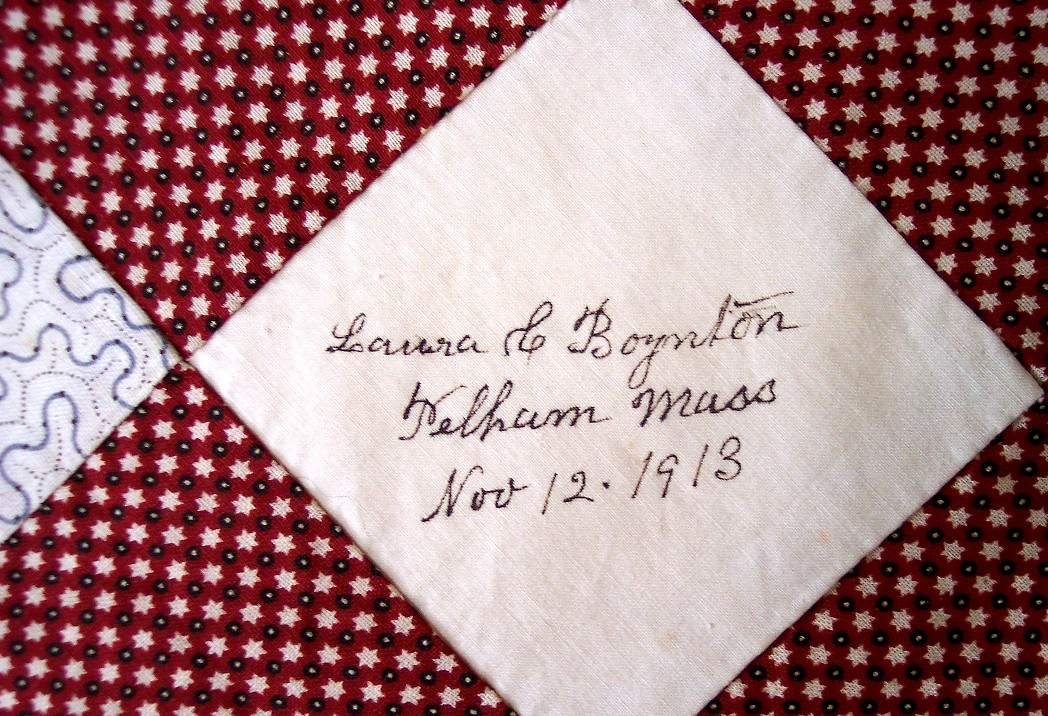
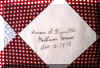 Laura
C. Boynton Pelham Mass Nov 12 1913 (the T could be a different letter) Laura
C. Boynton Pelham Mass Nov 12 1913 (the T could be a different letter)
Black Ink in script on plain white cotton; madder dyed rust with black cheerios
and white stars print; vermiculite worm pattern in gray on white with black
pin dots forming trail along the vermiculite; by hand
Nov. 12. 1913 Mr. + Mrs. C. K. Healey
Atlantic City N.J. (Mercer Healy in row 4, #4) Pencil script on a white
voile or organza type fabric, sheer but tight weave; Indigo (synthetic) with
white motif with a fancy stripe printed on; delicate dress print of tiny
flower bud with stem and leaf in red on white cotton; by hand
A.O. (?) Aiken Springfield, Mass (Emma Aiken in row 2, #3)
Black ink script stamp, City and state stamp is the same as Aiken block R2,
#3,and placed beneath it, but cotton it is printed on is different; double
pink with darker pink springs and white dots printed on; woven plaid, tiny
grid in beige and light blue; by hand
Lizzie Stedman Holyoke Mass. Nov.
12. 1913.
Black ink script on a slightly heavier cotton; double pink chambray, of dk.
Pink on bubble-gum pink ground; light blue 1" grid woven on white cotton
made to look like the stem or outline stitch; by machine
Bertha M. Dame Springfield Mass.
Nov. 12. 1913 Same name, different date R2,#6 Black ink script, looks
completely different than the other block's penmanship indicating they were
not written by the same person, written on a medium weight white cotton;
medium blue linen solid; by machine, seams pressed open
Silas Eaton Holyoke Mass. 1913
Embroidered with Turkey red floss in script in outline stitch, on a slightly
used looking white cotton; medium gray cotton satine solid; textured-look
(faux texture) cotton shirting print in blue and black fancy stripes
Row 4, #1 left
F. W. Smith. Rutland, VT. Nov. 12,
1913 Written so straight, he probably used a line. Black ink script on white
cotton; gray chambray with a thin white strip and motif set wide apart, a
shirt fabric; blue on white textured shirting, fancy; by machine, seams
pressed open (could this be the son or father of Frank Smith, Row 4,#6?)
Harold E. Frisbie Springfield Mass
Nov. 12, 1913
Embroidered with Turley red floss in print, stem stitch on white cotton; white
on black print, rows of dots with pansy type flower scattered around; black
on white shirting with similar lines of dots and an occasional hexagon shape
motif; by hand
Helen B. Smith. Rutland, VT. Nov.
12, 1913 (3 other Smiths from Rutland in this row) Black ink script with
same pen on same fabric as #1 block, different handwriting, but used a line;
dark red solid cotton, broadcloth?; black on white shirting print stripe,
feminine feel; by machine seams pressed open
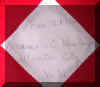 Nov.
12. 1913
Mercer E. Healey Atlantic City N.J. (same penmanship as R3, #2) Nov.
12. 1913
Mercer E. Healey Atlantic City N.J. (same penmanship as R3, #2)
Pencil script on a voile or organza white cotton; medium red solid cotton; thin
black lines set far apart on white cotton ground, some spatter stain (blood
?) on one triangle, by hand, seams pressed open
Myra A. Smith. Rutland, VT. Nov. 12, 1913 (Same pen and cotton as R4,
#1&3)
Black ink script on white cotton, used a line; very dark indigo solid cotton;
rayon crepe, (maybe a blend with cotton?) white with a black dash of thread,
all in a texture of crepe; by machine, seams pressed open
Frank W. Smith, Rutland, VT.
October 9, 1913 (Same pen and cotton as the 3 above). Same fabrics and
making as F. W. Smith block in R4, #1. perhaps it's father and son?
Row 5, #1 left
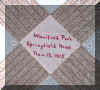 Winnifred
Pool
Springfield Mass Nov. 12, 1913. (Wm Pool row 1 ,#4 , in same style) Hand
embroidered TR floss, white plain cotton, tan grd. With raised blue and
white variegated thin strips and thin blue stripes, geometric basket weave
print in blue on white. Winnifred
Pool
Springfield Mass Nov. 12, 1913. (Wm Pool row 1 ,#4 , in same style) Hand
embroidered TR floss, white plain cotton, tan grd. With raised blue and
white variegated thin strips and thin blue stripes, geometric basket weave
print in blue on white.
Mildred A. Stedman. Holyoke, Mass.
Nov. 12, 1913. A pen resembling the look of a very thin felt tip marker is
used to print the name in black on a white plain cotton square. The 2 in 12
is illegible due to a heavy touch. Indigo blue, looks synthetic, with a
large white paisley and white dot for the print, pink and white woven
gingham.
Irma M. Taylor. Westfield Mass.
Sept. 20, 1916. Black ink by hand on white cotton square. Geometric brown on
white men's print for pjs or shirt with a black on white dress print or
shirting.
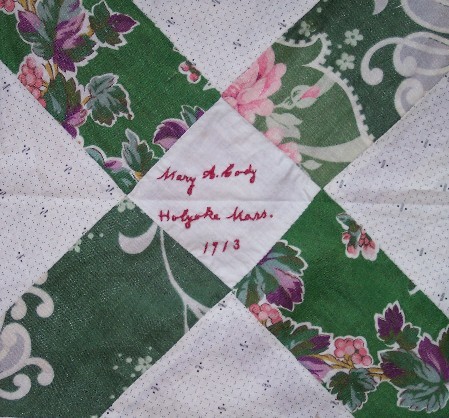
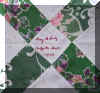 Mary
A. Cody Holyoke Mass. 1913 Hand embroidered in TR floss in her
penmanship on a plain white square. Large scale cotton sateen furnishing
print, green ground, white, pink and purple print, with a tiny and delicate
black on white shirting neat print. Mary
A. Cody Holyoke Mass. 1913 Hand embroidered in TR floss in her
penmanship on a plain white square. Large scale cotton sateen furnishing
print, green ground, white, pink and purple print, with a tiny and delicate
black on white shirting neat print.
Carrie Ainsworth, Westfield,
Massachusetts November 12, 1913 (signed 2 blocks with type, row 1, #2) All
typewritten in black on natural muslin square. Cadet blue ground with a
white cheerio motif, and a black on white plain printed check of thin even
lines.
Miss Edith G. Sherman, West Springfield, Massachusetts, November 12, 1913.
(Mrs. Nellie Sherman row 6 #2, also typed)
All typewritten, some is very faded, on white plain cotton square. Man's larger
check shirt, blues and gold on white, with a man's textured shirting of
white on white stripes with an occasional light green stripe.
Row 6, #1 left, top row of quilt top
Mrs. R. B. Corbatt, Holyoke, Mass.
Nov. 12, 1913. (Other Corbatt's in row 1, #3 & #6) Black inked signature on
plain white square. Black sprig print on white, with thin stripes of beige
and white textured shirting.
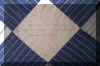 Mrs.
Nellie J. Sherman, West Springfield, Massachusetts, November 12, 1913.
(Mrs. Edith Sherman row 5, #6, also typed) Mrs.
Nellie J. Sherman, West Springfield, Massachusetts, November 12, 1913.
(Mrs. Edith Sherman row 5, #6, also typed)
All typewritten on plain white square. Blue cambric with thin white stipe with
blue and gray on white textured shirting.
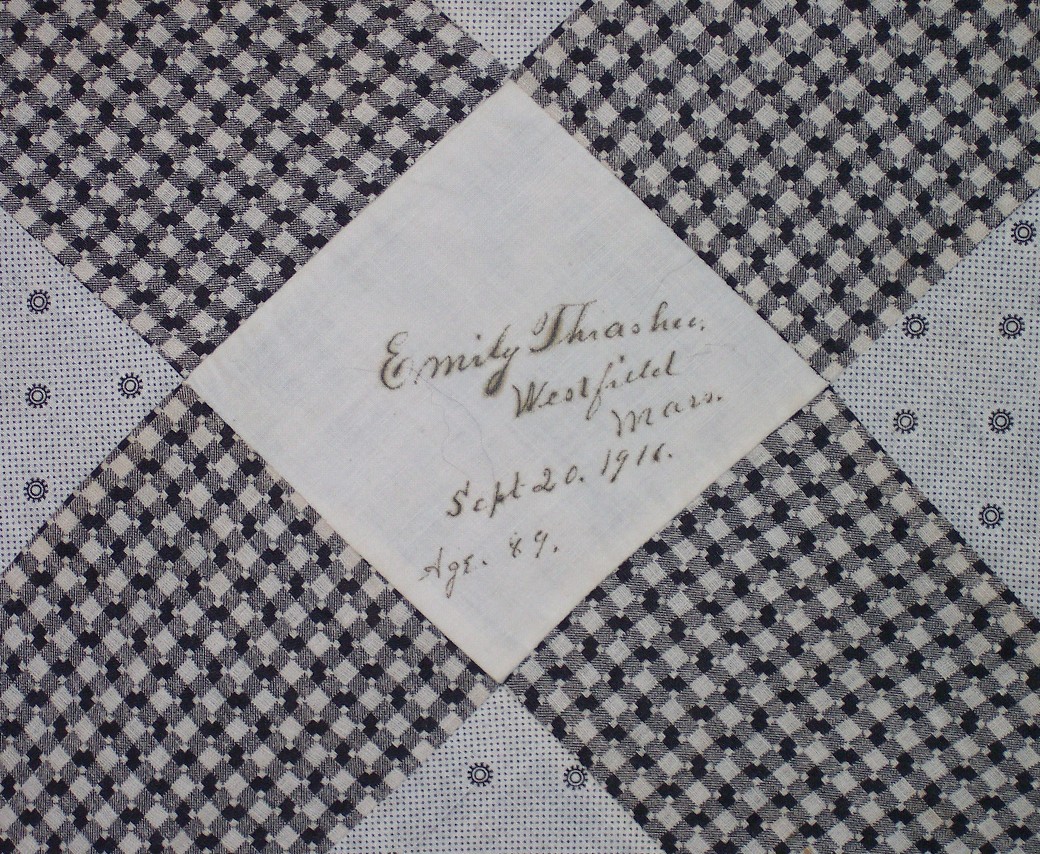
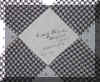 Emily
Thrasher Westfield Mass. Sept 20, 1916. Age. 89. Black ink handwritten
signature on plain white block. This is the only signature that includes an
age. This could lead someone to think it was made for her birthday, but its
masculine appearance conflicts with this somewhat, so it remains unanswered.
Black and white novelty check print with a navy on white neat and pin dot
print. Emily
Thrasher Westfield Mass. Sept 20, 1916. Age. 89. Black ink handwritten
signature on plain white block. This is the only signature that includes an
age. This could lead someone to think it was made for her birthday, but its
masculine appearance conflicts with this somewhat, so it remains unanswered.
Black and white novelty check print with a navy on white neat and pin dot
print.
Mrs. J. A Sackett. Westfield Mass.
Sept. 20, 1916. Black ink handwritten signature, very similar in style to
Emily Thrashers on the left, and is on the same plain white square as
Emily's. Black on white geometric print with small red polka dots, not
dense, on white.
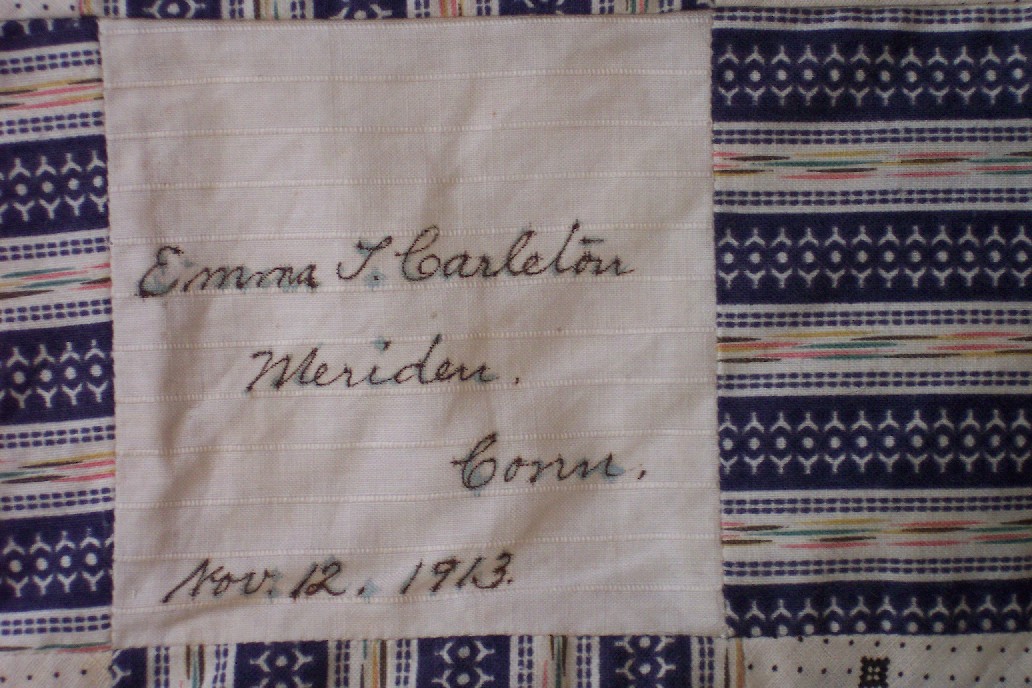
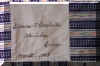 Emma
T. Carleton Meriden, Conn. Nov. 12, 1913. Black ink signature on
textured white stripe resembling lined paper and the signature is written on
it as if it were. Novelty stripe of faux texture in navy, green and
yellow/gold on white, with a navy and pin dot neat print on white. Emma
T. Carleton Meriden, Conn. Nov. 12, 1913. Black ink signature on
textured white stripe resembling lined paper and the signature is written on
it as if it were. Novelty stripe of faux texture in navy, green and
yellow/gold on white, with a navy and pin dot neat print on white.
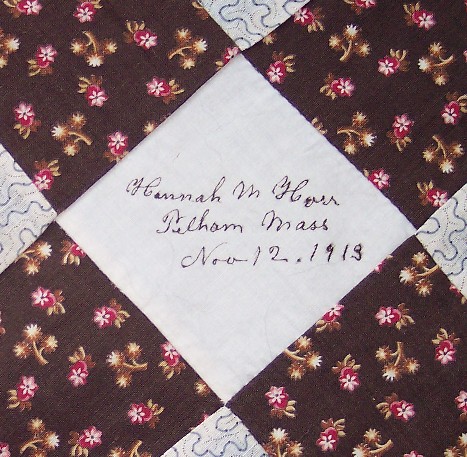
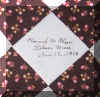 Hannah
M Horr Pelham Mass Nov 12, 1913 Black ink signature on plain white
cotton square. A brown ground with pink and white flowers and golden stems,
looks like an 1880s dress print, with another 1880s vermiculite gray on
white print and black picotage dots following the vermiculite trail. Hannah
M Horr Pelham Mass Nov 12, 1913 Black ink signature on plain white
cotton square. A brown ground with pink and white flowers and golden stems,
looks like an 1880s dress print, with another 1880s vermiculite gray on
white print and black picotage dots following the vermiculite trail.
Please contact me
if you have any information regarding the names on these signature blocks or
any relevant information that might further the documentation of this
signature top. Thank you!
Read more on:
Album &
Signature Quilt History, 1830 - Today: Revised September 2005
by Kimberly
Wulfert
|